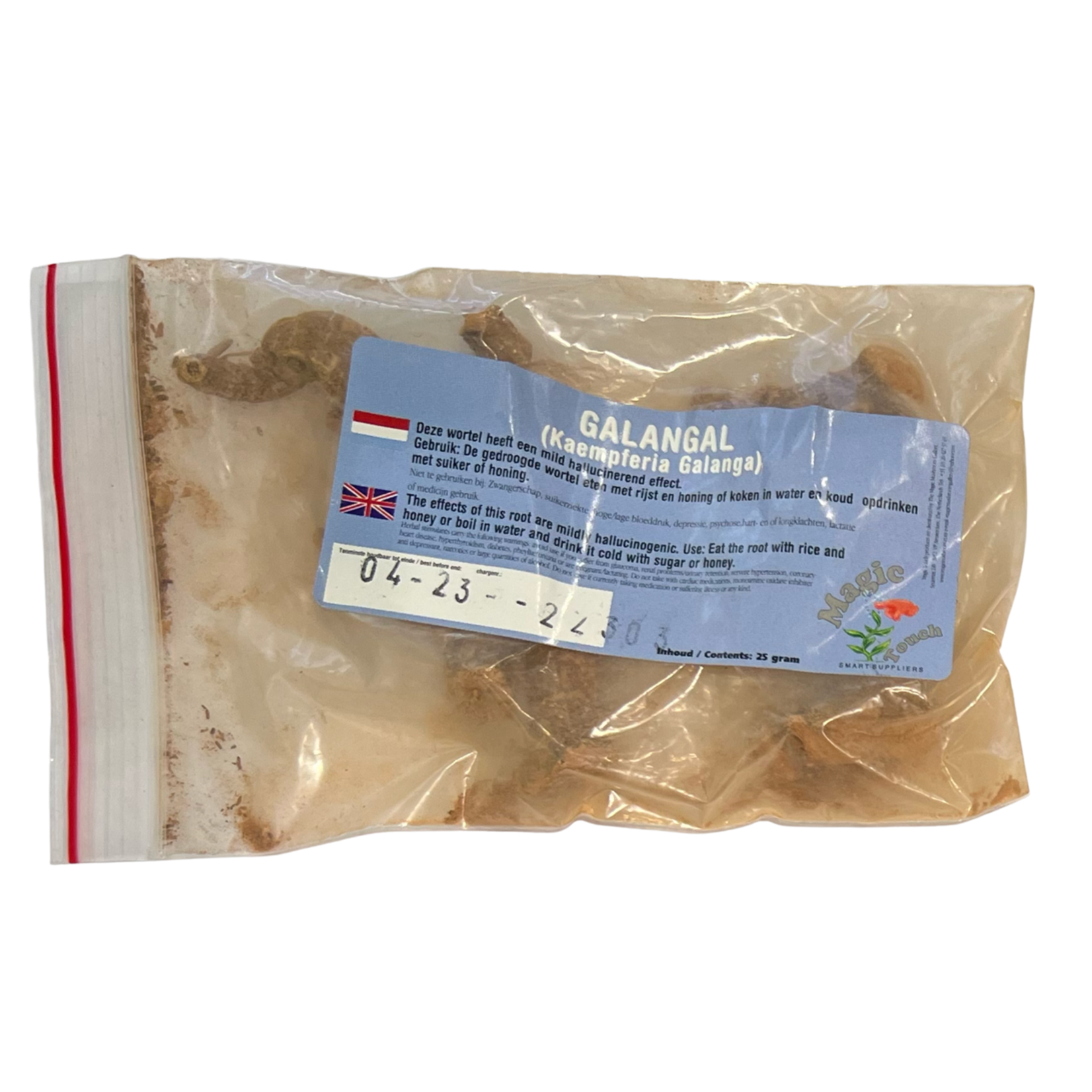
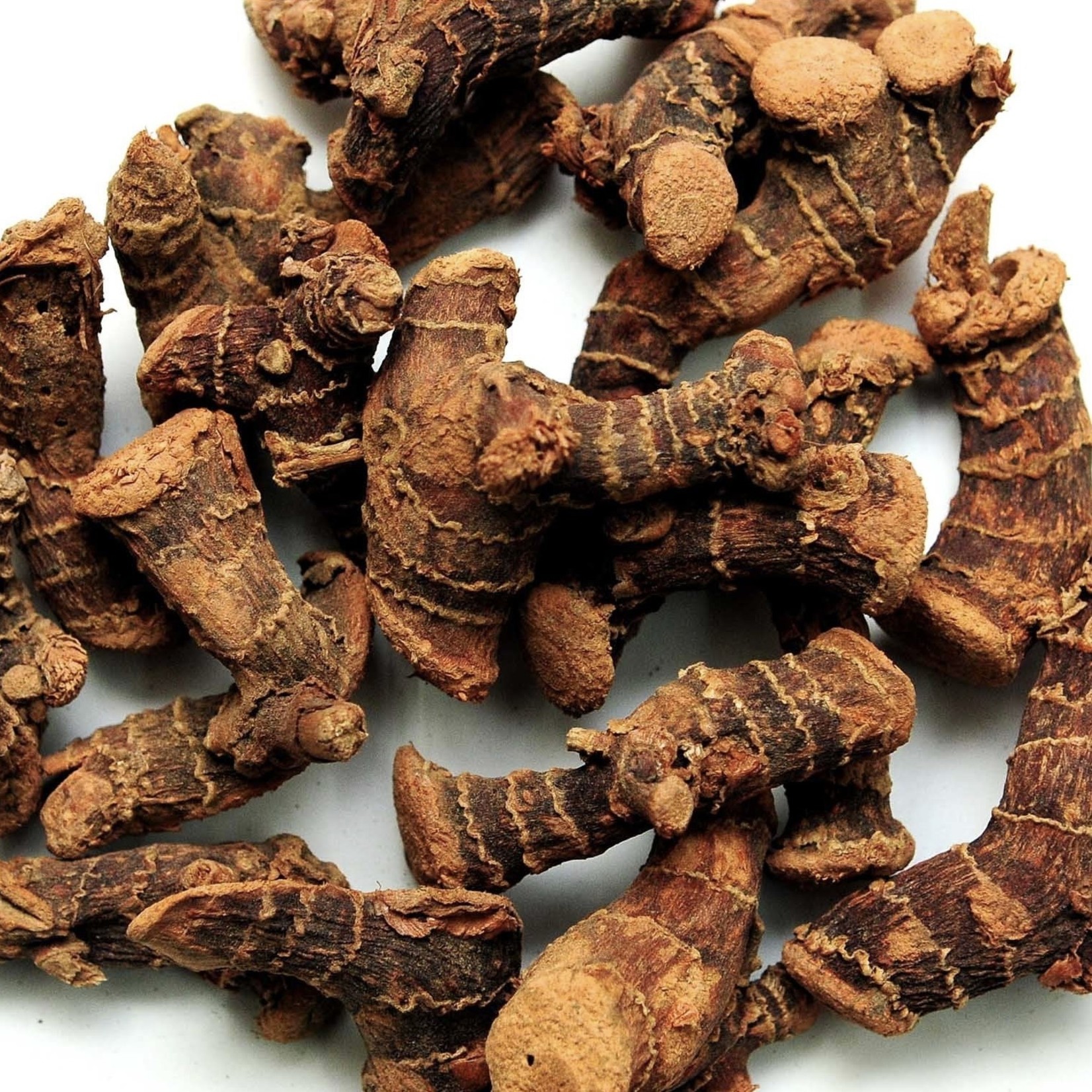
Galangal Root
Kaempferia Galanga
Usage:
Tea
- Make a tea as you would a ginger tea. Use an amount that gives you a satisfactory effect. You can drink the tea hot or cold, preferably with honey.
Raw
- Chew on 1 to 10 grams of the root.
Rice
- Eat the cut root mixed with rice and honey .
Galangal is a flowering plant. It is a culinary herb that is used to improve one's appetite and vitality. It's also a sexual stimulant with mild hallucinogenic effects.
Kaempferia Galanga is found in tropical areas of Africa, and in Southeast Asia.
Kaempferia Galanga is used as an entheogen and aphrodisiac in New Guinea. There, it is taken as part of the final three stages of initiation rituals along with species of Boletus mushrooms, and psilocybe mushrooms. Every species in the genus is prized for the highly aromatic rhizome, which is used to flavor rice, and as a medicine. In Malaysia, the plant was added to arrow poison prepared from Antians toxicaria. It is used to make incense in Japan. In Thailand, the root and leaves are put into curries as a flavoring, and the plant is used there as a medicine as well.
Being exposed to the vapors and smoke of wild galangal when burned as an incense is thought to increase energy and overcome exhaustion, melancholy, and sadness. Many Tibetan and Japanese incense formulas still contain galangal, especially in formulas to promote awareness, overcome physical exhaustion, and create a peaceful and contemplative internal environment.
Galangal was known to the ancient Indians, and has been used in the West since the Middle Ages. Its stimulant and tonic properties are recognized by the Arabs who ginger up their horses with it, and by the Tartars, who take it in tea. In India, the root is often chewed with Betel Nut (Areca Catechu). In the East, it is taken powdered as a snuff, and is used in perfumery and in brewing.
Another mystical property of this root is that, when dried, it may be reused several times when used for making tea. After making the tea, remove the galangal and let it dry. Reuse when you are ready for another journey to awareness.
Beyond the high content of essential oil in the rhizome, little is known of the chemistry of the plant. Hallucinogenic activity may be due to constituents of the essential oils.
The inhabitants of Mount Hagen, Papua New Guinea use the rhizome as a hallucinogen, and is said to produce hallucination without side-effects. They also report that it is an aphrodisiac, euphoric, and creator of pleasant and prophetic dreams. A Western report indicates that consuming the powdered root creates clarity of thought and visual alterations. Some reports indicate no effects from consuming galanga powder, but this may be due to the use of a type of galanga that is not genuine Kaempferia root.
The mild psychoactive effect is felt quite soon after chewing and swallowing a few teaspoons of Galangal root (especially on an empty stomach). You can experience a warm feeling, clear thinking and altered perception. Larger doses can lead to mild visual hallucinations.